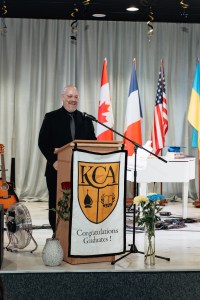
Mr Moore, KCA board, faculty, and staff, alumni, parents, and especially the class of 2026, thank you for giving me the honor and opportunity to be here today. Being the seniors’ Bible and social studies teacher, you have given me one last little opportunity to sneak in another lesson about God and history, and you know I’m gonna use it.
But before we do that, for those unfamiliar, what does an average day in the life of a KCA high school student look like? Well, they get here to school and head on up the stairs to take a couple classes. They come down for lunch, maybe an art or music class, then head back up for language arts or study hall. Finally, that last bell rings, they come down one last time and go home. That’s the expectation.
But the reality? The commute is twice as long as it should be because… traffic. When they finally arrive, they swing over to see Mary for a late pass before heading up to class. I’d throw in something about falling asleep in the bathroom, but that only happens to freshmen, not seniors. About halfway through the first class, there’s an air alert, and all the way down we go to finish the first class in the basement. Of course, that means there is no break because mean Mr Richardson claims, “you all took your break on the walk down here.” About halfway through our second class, the air alert is over, and our break for that class is the walk all the way back to the top. We come down for lunch and go back upstairs to a loud gym because the elementary recess is inside, thanks to the wind blowing in from the burned out building next door. Of course, there’s another air alarm around one, and all the way down we go again.
You get the picture. More than once, on days like these. I find myself reciting an old children’s rhyme: The noble Duke of York. He had ten thousand men. He marched them up the stairs. Then he marched them down again. So when you’re up, you’re up. And when you’re down, you’re down. And when you’re only halfway up, you’re neither up nor down.
Of course, I am going to share the history of the Dukes of York, and where this poem originally came from, but before that, there are three observations I would like to make. The first is that, just like a normal school day at KCA, the days we all experience in the school of life are full of ups and downs. Even if you never again walk up and down the steps of this school, in both big and small ways, your life will still be full of ups and downs.
The second thing to see is that usually not your fault. Most of the time the ups and downs in life happen to you rather than are created by you. Granted, this isn’t always true. When you are blankly staring at that chemistry test because you were up to 2 AM doomscrolling instead of studying and sleeping the night before, that’s on you. And the joy of celebrating your graduation right here and now, others helped, but you earned what you are getting here today. But having to leave the school for a couple and even the country for a couple of years is not your fault. That drone hitting the front yard and the missile hitting next door would have happened whether you were here or not. And most of the blessings and challenges you will experience will come your way, no matter what you do.
Finally, there is the Christian corollary. Life is a series of ups and downs. And Jesus said we would have life more abundantly. In Psalms 16 and 21, David says that in God’s presence, we have the fullness of exceeding joy. Peter calls it exceeding and inexpressible joy in 1 Peter 1 and 4. Jesus said he has taught us so that his joy may be in us and that our joy may be full. But Jesus also said that in this world his followers will have trouble. And in Matthew 10 he said if people will treat him poorly, how much worse will it be for His followers. So if this is life… life in Jesus is…
So what lessons can the Duke of York teach us about marching up and down the hills and valleys of life? Well, first of all, there are actually three different Dukes of York who are candidates for being the subject of this rhyme. For each of these, there is one specific life lesson we can learn. The first of these lessons has best been said by that famous philosopher and theologian, Luke Skywalker. “Attention, air raid alert. Proceed to the nearest shelter. Don’t be careless. Your overconfidence is your weakness.”
Mark Hamill’s advice on the Ukrainian air alert system is advice Richard the Duke of York should have listened to. At the beginning of a civil war called the War of the Roses, the Duke marched up to Sandal Castle with about ten thousand men. At this time, cannons were a fairly new technology, and Richard could have held that castle for as long as he wanted. But he overestimated his talents as a leader and underestimated the strength of the enemy at the bottom of that hill. His overconfidence was his weakness. Because Richard didn’t use his head, he lost his head.
I have climbed a few mountains in my younger days. Two things I have learned from literal mountaintop experiences: they are inspiring, and you can see for miles. But nothing grows on the tops of mountains. Life and growth happen in the valleys. It is in those down times that you grow, mature, and develop into what God wants you to be. So whether God is bringing you awe inspiring and vision casting ups or down times that are the testing of your faith. Take them seriously. God has given you both for a purpose.
Take them seriously, but don’t let them rule you. That was the mistake of the second Duke of York. Before ascending the throne, King James the Second was the noble Duke of York. He wasn’t a very popular King. He was a Catholic king who went out of his way to offend his Protestant Nobles. So they started calling him the Duke of York again and invited his daughter, Mary, and her husband, William, to become the new king and queen of England. You seniors actually taught this class in government when we did the English Bill of Rights.
James came up from London to Salisbury with about 30 thousand men to confront these usurpers. But before either side could even think about battle, he chickened out and went running back to London. He threw the royal seal in the Thames River, disguised himself as a servant, and fled the island.
Don’t let fear steal your crown. Normally, when we talk about fear, we think of big things. Air raids. I’ve lived through multiple huge earthquakes, a typhoon or two, and helped do cleanup on one of the biggest tornadoes to ever hit the Midwest, less than an hour’s drive from where I lived at the time. Fear isn’t always, not even usually about things like these. The fear that has the potential to steal our crown is the fear that comes not from what is happening, but what might happen.
It wasn’t a battle that sent James running. It was the fear of an upcoming battle. He outnumbered his opponents. He could have had the better strategic position. Instead, he ran before the first sword was even drawn. If you run from the fear of what might be, you will live the rest of your life with the regret of what could have been.
The third lesson we can learn comes from the most likely source for our poem, young Prince Frederick, who was the Duke of York during the Flanders Campaign in the 1790s. This was the first time the young prince was out on his own in a leadership position. After a few early successes, he was constantly pulled in different directions by greedy politicians in London, incompetent officers around him, and untrustworthy allies who had their own agendas. He was constantly listening to whatever competing voice he most recently heard, in effect going up and down hills while getting nowhere. As a result, the campaign was a disaster.
But Prince Frederick wasn’t. Once he returned to London, he became the Commander-in-Chief of the British Army. In that role he made changes to the promotion system as army structure and doctrine so that such mistakes could never be made again. In effect, he created the foundations of the army that would soon be able to beat Napoleon and become the dominant fighting force in the world for the next century. He Learned From His Mistakes.
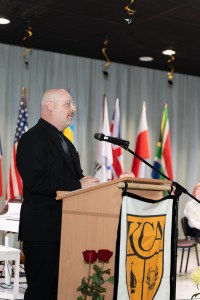 After today, you graduates will be setting out from here into your college or careers for the first time outside of the protective shelter of your family. Along the way, you are going to make some mistakes. That isn’t a warning. That isn’t pessimism. It is just plain hard fact. We all do. The question is, what will you do with those mistakes? Will you learn from them, step up and become better, or will you run from them, dooming yourself to a life of mediocrity? Your potential biggest failures will not be the mistakes you make but your unwillingness to learn and grow through them.
Now that you have graduated from school, your real education is about to begin. As it does, the life ahead of you is guaranteed to be full of ups and downs. They are inevitable. So when they come, take them seriously, but don’t let them rule you. Instead, learn and grow through them and watch what God will do in your life.
Ladies and gentlemen, here is the class of 2026. Graduates, here is the world. Go get it.


I am not certain how many people know anything about Kiev Christian Academy… KCA is a little ambiguous.
Anyone who is reading my monthly misisons updates would know about KCA.