But he was pierced for our rebellion,
crushed for our sins.
He was beaten so we could be whole.
He was whipped so we could be healed.
Isaiah 53:5
Read: Isaiah 53, Colossians 2:6-15
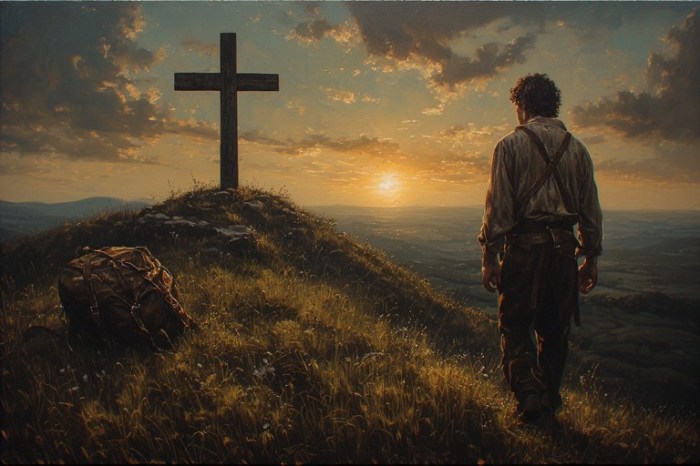
Relate: There are moments in every pilgrim’s journey that divide all of life into two halves. For Christian, standing at the foot of the cross is exactly that kind of moment. He has been walking with that burden strapped to his back for what feels like forever. Through the Slough of Despond, past Mr. Worldly Wiseman’s detour, through the Wicket Gate, and all the long miles down the King’s Highway, the weight that pack has bent him double and worn grooves into his shoulders. Now, at this simple, unadorned place, the thing he has been unable to shed by any effort of his own simply falls. It rolls away. It tumbles into the empty tomb. And it is gone. Bunyan doesn’t linger here. He gives it a few short lines. Maybe because the moment is too holy for a lot of words. Maybe because, as he knew from his own years of wrestling with guilt, no description can ever be adequate.
React: This is not an intellectual picture of what the cross does. It goes deeper than the mind. Christian doesn’t figure out atonement at this moment. He doesn’t work through a systematic theology of substitution. Such theology is absolutely essential. But not at this moment. Here, Christian is simply undone and remade. The burden was his sin. It was not just the feeling of sin, not just the social consequences of it. It was the actual weight of guilt and judgment that the Scripture speaks of in Psalm 38 and Isaiah 53. It was killing him. It would have killed him. The cross is the only place in all of Bunyan’s allegorical world, and in all of the real world too, where that weight can be removed. You can take the long road around Legality’s village. You can try to shrug it off by willpower. But you still will walk through your life bent over. The cross alone breaks the yoke.
One thing I have always wondered at is why the cross sits in Stage 3 and not in Stage 1. Christian has already passed through the Wicket Gate before the burden falls. Scholars and pastors have wrestled with what Bunyan meant by this sequencing. Was the gate saving faith and the cross assurance? Was it all one conversion stretched across time? This latter would fit with Bunyan’s own story in Grace Abounding. The honest answer is probably: probably. One thing that is absolutely clear is that is not a bug in the story. It is a feature. Many of us know exactly what it is to have entered the narrow gate and still be walking with a weight we haven’t yet surrendered to the Lord. God has saved us, but there is still healing and heart work that needs to happen. The good news Bunyan is pressing home here is that the cross is on the King’s Highway. You don’t have to leave the path to find it. Keep walking. It is ahead of you.
Respond:
Dear God,
I am so grateful for the cross. I am thankful for setting me free. This is not just spiritual liberation, but the cross has set me free emotionally, and mentally, and socially. The gospel is not just that I will one day go to heaven. The gospel is also that today, my burdens can be lifted.
Amen


Pingback: Pilgrim’s Progress: The Cross & The Sepulcher (3:1) – httpsinc009