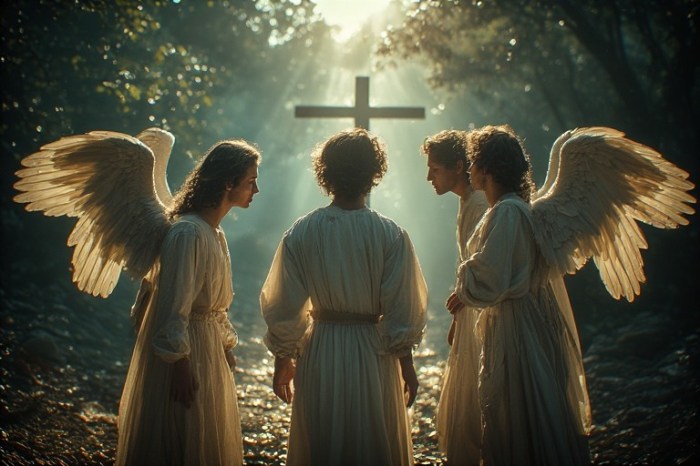
The angel spoke to those who were standing near him.
He said, “Take his dirty clothes off.” He said to Joshua,
“I have taken your sin away. I will put fine clothes on you.”
Zechariah 3:4
Read: Isaiah 64:1-9, Zechariah 3
Pilgrim’s Progress Stage 3 Part 2
Relate:
Right on the heels of the cross, three shining figures appear to meet Christian. One declares his sins forgiven. Another strips off his old rags and dresses him in new clothes. The third sets a mark on his forehead and presses a sealed roll into his hand. Three acts, three figures, one seamless gift. These shining ones are representative of the work of the Trinity at the moment of justification. Bunyan wants you to see all three members of the Godhead active and present in the transformation of the newly freed pilgrim. No Person of the Trinity stays home when Christian finds freedom at the cross. They are all there, and they are all working.
The stripping of the rags and the clothing in new garments carries the full weight of the righteousness of Christ. Christian has nothing to offer. His own goodness, his “filthy rags,” are no longer adequate or appropriate. Like Joshua in Zechariah, and like the great multitude from every tribe and nation in Revelation, he needs new clothes. He is clothed with a righteousness that is not his own. This is not a secondary point in Bunyan’s theology; it is a pivot on which the entire story turns. Christian is not now just a better version of his old self. He is clothed in something entirely new that does not belong to him by nature. It is the only kind of righteousness that can actually stand before a holy God. The mark on his forehead, an echo of Revelation’s seal of ownership, tells the watching world, and the enemy, and the pilgrim himself: this one belongs to the King.
React: As important as the clothes and the seal are, however, they are barely mentioned again throughout the remainder of Christian’s journey. In contrast, the scroll plays a prominant roll in the story to come. Without giving spoilers for first-time readers, it is still safe to say that there are excellent theological reasons why Bunyan writes Christian’s journey in this way. Probably, besides Bunyan himself, no other individual had a greater impact on the spiritual life of England than did John Wesley. From a Wesleyan perspective, the clothes represent the dying to the old man and putting on the new that happens at justification. The mark represents the seal of the Holy Spirit found in Ephesians 1, 4, and 2 Corinthians 2. The scroll represents the active living faith of the believer that must be maintained. Over and over again, the importance or even necessity of reading and holding onto this scroll is brought up. Over and over again in scripture, we see that salvation is a work that God has done in us, but also something we are commissioned to hold firmly to. (Heb 3:14, 10:23, 1 Corinthians 15:1-2, 16:13, Revelation 3:14 etc)
Respond:
Dear God,
I thank You that You have saved me. I am so grateful for what You have done in my life. You have clothed me in Your righteousness. You have placed Your seal on me. I am fully Yours. Help me to walk and live in that truth. Help me to cling to it no matter what the journey of life might bring. Let me never take it for granted. I cling to You in surrender. I am fully Yours.
Amen

