This is what the Lord says:
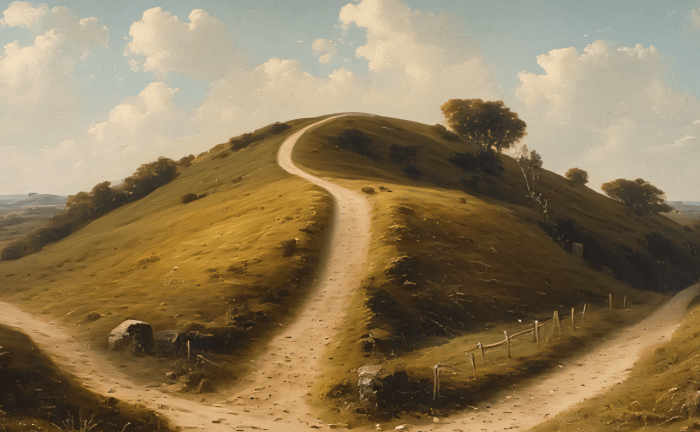
“Stop at the crossroads and look around.
Ask for the old, godly way, and walk in it.
Travel its path, and you will find rest for your souls.
But you reply, ‘No, that’s not the road we want!’
Jeremiah 6:16
Read: Jeremiah 6:16-21, Jeremiah 13:15-19, Matthew 7:13-14
Pilgrim’s Progress Stage 3 Part 5
Relate: After a while, the road brings Christian to the foot of a hill called Difficulty. The hill goes straight up. It is steep, rocky, narrow, and demanding. On each side of it, there are other roads that seem to go all the way around. One side road is called Danger and the other is called Destruction. If we didn’t know the names of these roads, they would look like reasonable alternatives. They appear level. They both look like the kind of sensible detour a reasonable person might take to avoid unnecessary hardship. Why suffer hardship if it is not necessary? Formalist takes one side road and Hypocrisy takes the other. They each disappear down the way and are never heard from again. Christian, reading the inscription at the base of the hill and weighing his options, begins to climb.
Maybe it is the writing style of a different time. Maybe it was absolutely intentional, but Bunyan makes this as straightforward as possible. The two easy roads are literally called Danger and Destruction. They are labeled. They announce their own destinations. Even still, Formalist and Hypocrisy take them. This is not because they are stupid. It is because self-sufficiency makes a person functionally illiterate when it comes to spiritual warning signs. When we are on the road by our own effort and custom rather than by grace, we will always default to the path that looks manageable in our own strength. The climb up Hill Difficulty is not for people who are trusting in themselves. It requires the kind of resolve that can only come from knowing that the One who called us to climb it is greater than the difficulty ahead.
React: The narrow and upward path is a constant theme in Scripture. In the Sermon on the Mount, Jesus speaks of the straight and narrow gate. Jesus also promises that following him involves us taking up our cross daily. That is not easy. But we should also be wary of romanticizing difficulty for its own sake. This is something I struggled with earlier in life, and it is still a danger. God has called me to hard places. But He doesn’t call me there because they are hard.
Bunyan is not suggesting that Christians should seek hardship as if the pain itself were sanctifying. He is saying something more precise. The road to the Celestial City goes over hills, not around them. Shortcuts are rarely true shortcuts. They are traps with pleasant names. Every generation of believers faces its own version of the roads Danger and Destruction. There are always paths that promise an easier Christianity. They promise a less costly discipleship, a faith that doesn’t require the climb. But little faith is truly required, and no discipleship actually occurs. These “shortcuts” are clearly marked for those with eyes to see it. The question is whether we are reading the signs.
Respond:
Dear God,

